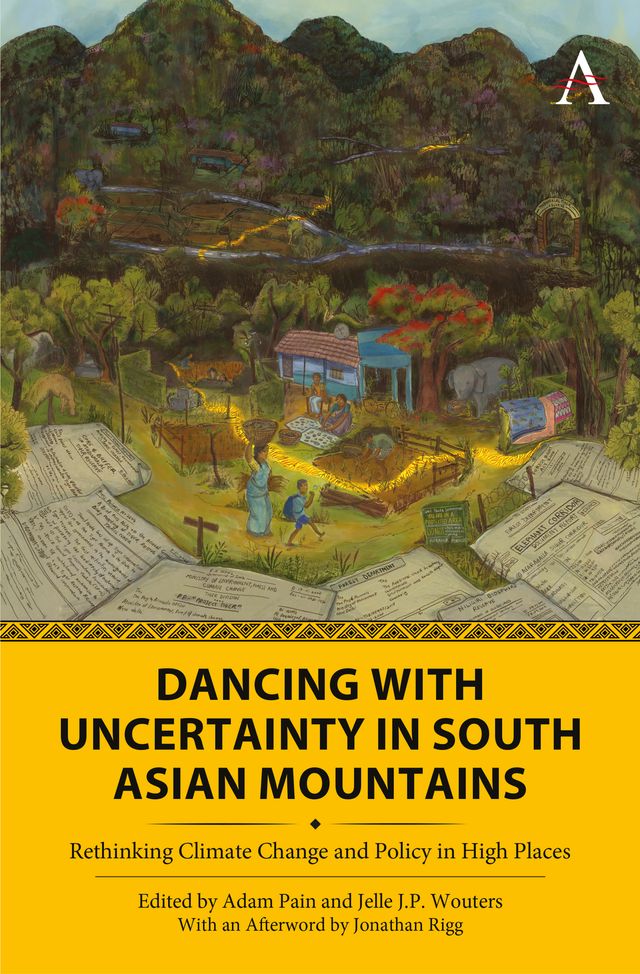


Edited by Adam Pain and Jelle J.P. Wouters
ISBN: 9781801360746
Pages: 250
Pub Date: January 2027
Imprint: Anthem Press
A powerful exploration of how climate change is turning the mountains of South Asia into landscapes of uncertainty, where communities, ecosystems and institutions struggle to adapt to an unpredictable future.
This book explores the many faces of uncertainty in the mountains of South Asia – landscapes, livelihoods and lifeways that now stand at the frontline of global climate change. Across these high-altitude worlds, uncertainty has seeped into everyday life, shaping the contexts and experiences of individuals, communities, science and policy-making, and multispecies worlds. Farmers grapple with weather and livelihood uncertainties, mountain scientists find their methods and models outpaced by runaway climate change, forest animals change their behaviour in inexplicable ways, and policy-makers struggle to plan for unknown climate futures. Running through all these experiences, there is a pervasive sense of uncertainty, laced with anxiety and apprehension.
Through groundbreaking conceptualisations and lively case-studies, this book traces the fracturing of resonance and the ensuing uncontrollability of life as ‘poly-uncertainties’ now suffuse, variously, lives and livelihoods, forests and fields, cultures and cosmologies, the climate sciences, policy practices and future imaginations. While uncertainty has always been part of life in mountain environments, it has acquired a new intensity and visibility as South Asian mountains emerge as one of the world’s most fragile climate frontiers.
The case-studies gathered here unfold across the Himalayan landscapes of Bhutan and Nepal and the Western Ghats of India. This is a global climate frontier because of these mountains and hills’ deep time, life-enabling and sustaining ecological endowments for the habitability of places in interlinked mountains and surrounding plains of South Asia. Yet, they are also profoundly vulnerable to cataclysmic disruption so that climate change in high places may have devastating consequences both within and beyond the mountains themselves. In this climate frontier, the effects of climate change are both causing uncertainties directly through socio-ecological unravelling and indirectly through their entanglement with pre-existent crises caused by the ambiguities of state policies, market relations and laws. Thus, while climate change represents only one dimension of the larger uncertainty narrative of South Asian Mountains, its effects infuse, overlay and exacerbate other and older uncertainties.
This book argues that uncertainty should no longer be understood merely as an existential corollary to life. In the anthropocenic mountains of South Asia, uncertainty has become the defining context within which all human, scientific and institutional activities are entrenched. This demands a shift away from dominant scientific and policy paradigms that seek certainty and control, and towards approaches that learn to manoeuvre with uncertainty itself.
Such manoeuvring often takes the form of structural and individual improvisations shaped by risk pools, repertoires, conjunctures and chance. Life in high-altitude worlds increasingly resembles an improvisatory ‘dance’ of adapting, adjusting and responding: a Dancing with Uncertainty. In the upshot, it is increasingly the (in)capacity to face uncertainty that orients life, livelihoods and liveability. Uncertainty should therefore become part of our conceptual toolkit and the emergent dialogues on the future of society, climate change and policy in South Asian Mountains particularly, but also elsewhere.