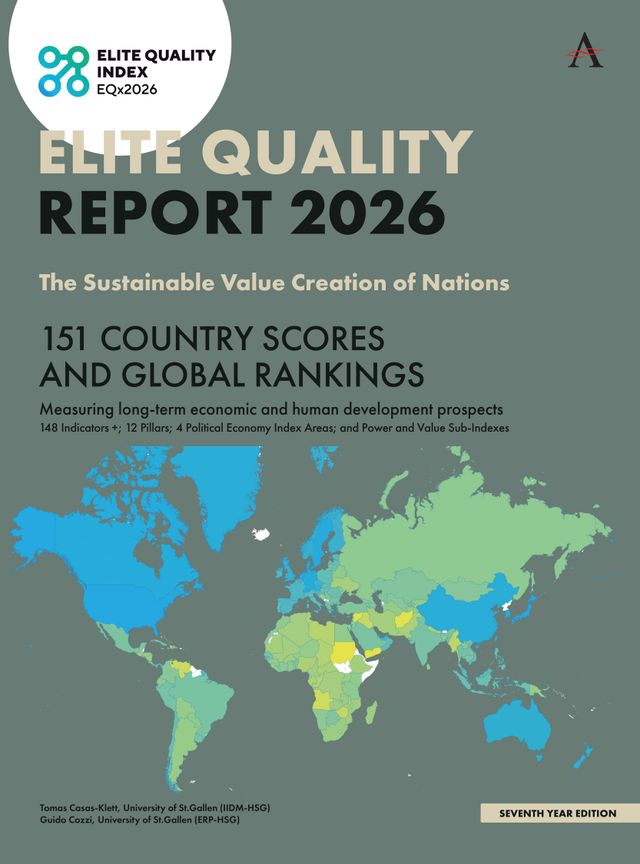


Edited by Tomas Casas i Klett and Guido Cozzi
ISBN: 9781801361934
Pages: 350
Pub Date: November 2026
Imprint: Anthem Press
Singapore maintains the top position in the EQx2026 for the seventh consecutive year. The United States surged back last year and retains the second place, powered primarily by its commanding lead in artificial intelligence. Japan rises to third, while China delivers one of the most remarkable performances, climbing eight places to #11 which is the highest ranking ever for a non-advanced economy. Overall, Asian economies continue to strengthen their position in global elite quality.
The results also highlight important trends: several traditional high performers (Switzerland, UK, Australia, Israel, Norway) are experiencing mostly minor but steady declines, underscoring that elite quality is not permanent: it requires continuous creative destruction, sustained value creation through productive risk-taking, and the constant constraining of value-transfer activities. In parallel, many emerging markets (Brazil, Turkey, Egypt, South Africa) show significant recovery. Europe continues to lead in the Next Generation Value Creation Barometer (NGVCb), yet its overall elite quality is declining, raising concerns about long-term intergenerational sustainability.
The Elite Quality Index 2026 (EQx2026), the seventh edition of the world's leading comparative political economy index, ranks 151 countries by the quality of their elite business models. Elite quality is defined as the capacity of elites to create sustainable value for society rather than extract it through rent-seeking and other value-transfer activities. Drawing on 148 indicators, the EQx operationalises elite quality on a global scale, offering a comparative lens on long-term economic growth and human development.
The EQx2026 supplies aggregate measurements like its 4 Index Areas and 12 Pillars, which include Creative Destruction, or Unearned Income that serve to diagnose the specific strengths and weaknesses of a specific country’s elite system.
A foundational innovation of the EQx is its inclusion of ‘Power’ as one of its two Sub-Indices (the other one is ‘Value’). Power is seen as being a key predictor and enabling mechanism for future extractive value transfers. At the most granular level, the EQx’s 148 Indicators provide a stand-alone analytical lens that seek to describe and explain specific value creation and extraction (rent-seeking) phenomena in the political economy and their links to elite agency. The EQx2026 provides novel insights that will allow policymakers, academics, journalists, business leaders, students, and concerned citizens understand how elites are impacting the political economy of their nations while also allowing them to benchmark countries that perform well (or poorly) in terms of economic growth and human development.