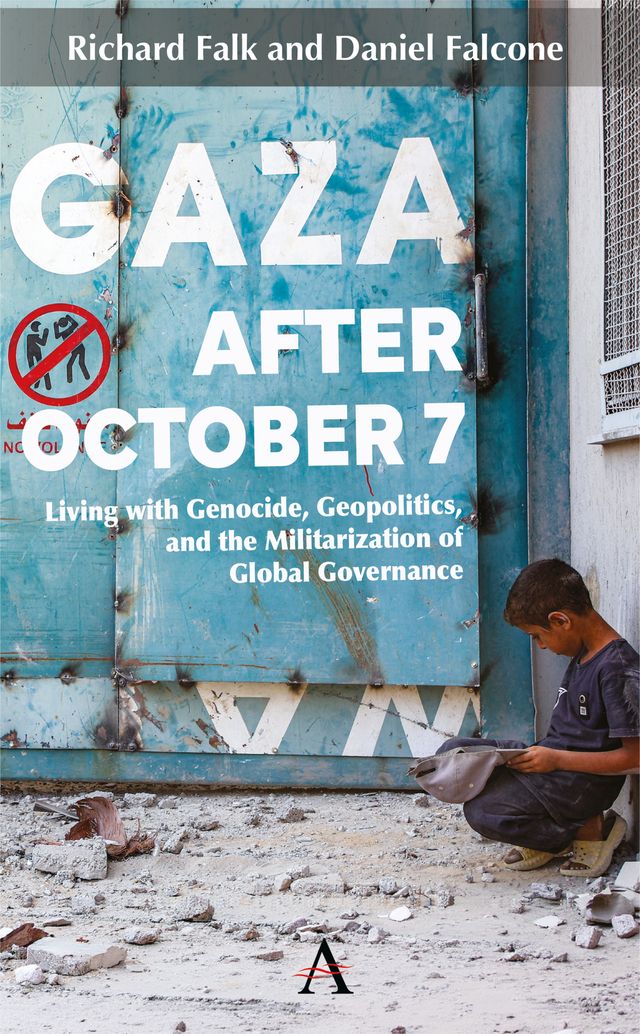


Richard Falk and Daniel Falcone
Paperback
£25.00 / $35.00
Hardback
£80.00 / $120.00
eBook (WEB PDF)
£25.00 / $35.00
eBook (EPUB)
£25.00 / $35.00
ISBN: 9781801362511
Pages: 180
Pub Date: April 2027
Imprint: Anthem Press
Examines the Gaza conflict through the lenses of human rights, geopolitics, media, and international governance, analyzing how power, legitimacy, and public perception shape the crisis.
The book looks at the Gaza–Israel conflict post October 7 and provides a consistent focus on human rights, media influence, and the ways power, legitimacy, and sovereignty form events in real time. The book’s earlier chapters focus on October 7, the UN, and the Rafah offensive—as they show how geopolitical analysis describes the events. Furthermore, this book scrutinizes disinformation and explains how deflection can serve as a tool of statecraft. This tactic inevitably obscures global understanding and government accountability, thereby reinforcing unequal power relations. As this narrative takes shape, Falk and Falcone turn more directly to the humanitarian catastrophe in Gaza and the dynamics surrounding the region. This includes colonization in the West Bank, the Iran–Israel War, and the displacement (and incredible resilience) of the Palestinians. The book points to an ever-widening crisis of legitimacy as Palestinian journalists are killed. Furthermore, the book emphasizes that the politicization of international law is contested, while the agenda-setting press embraces deep-seated political interests, thus altering the global discourse. In short, an additional question of sovereignty becomes central as the tragedy expands beyond Gaza. The final portions of the book focus on Greater Israel, “the peace plan,” institutional breakdowns, and the collapse of global governance. The authors explain the failures of international organizations to effectively prevent massive levels of state violence. They discuss internal dissent within frameworks and institutions and these include debates over the role of the UN special rapporteur, genocide, and international legal bodies. Their work covers the proposals for postwar arrangements; here, human rights are recentered once again as the authors set out to explain both displacement and disarmament. Falk and Falcone address the competing political visions for Gaza’s future that ultimately ask if self-determination can succeed. This book is timely and shows the speed of the erosion of credibility in the era of international diplomacy, where legal norms have reached intense polarization and severe institutional paralysis.