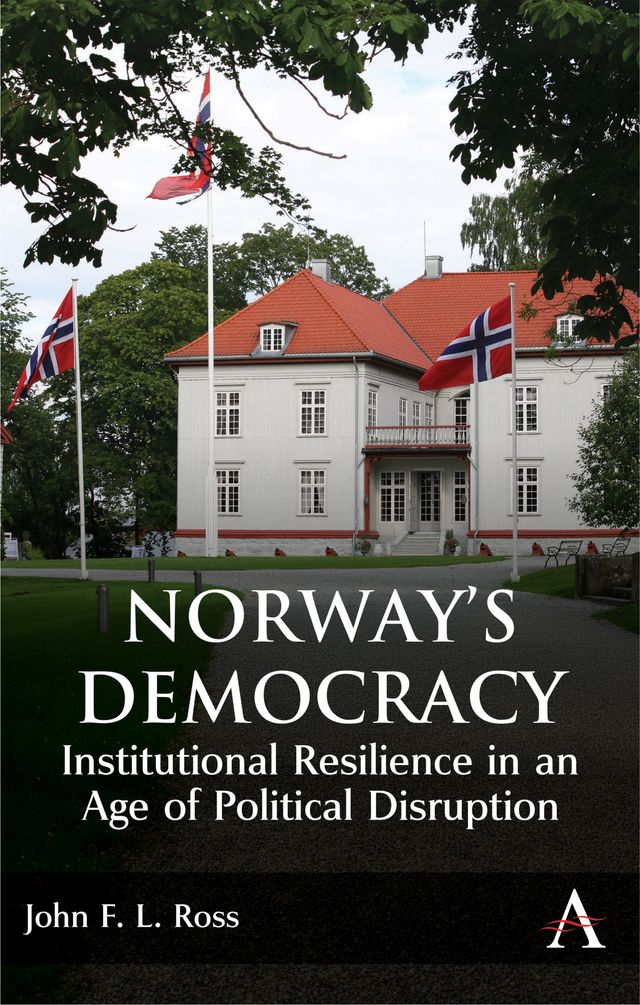
John F. L. Ross
ISBN: 9781801361927
Pages: 300
Pub Date: March 2027
Imprint: Anthem Press
Nordic Europe, practically a byword for stable polities and a home of social democracy, is far less known for its role in liberal democratic development. Norway in particular is typically passed off as a latecomer, ever a step behind its politically better-established neighbors, gingerly traversing the treacherous shoals of international politics. In this pathbreaking new study, John Ross vigorously challenges this flagging narrative of political passivity, demonstrating how Norway emerged as an institutional pioneer from 1814—part of the advance team of democracy—and parlayed those early beginnings into the top-ranked democracy of today. It is a quietly astonishing, institution-driven double act of promise and performance, dissected in Norway’s Democracy for the first time by a non-Scandinavian.
With a lively pen and studious aversion to Scandinavian cliché, drawing on exceptionally wide source material and unparalleled comparative insights gained teaching and researching in seven celebrated democratic settings, Ross emphasizes the chronically overlooked structural basics long girding Norway’s unusual democratic experiment. His thematic approach swings attention away from the outcome-oriented, behavioral elements so characteristic of most Nordic studies. Ross disputes blithe “gradualist” notions that Norway evolved seamlessly into the democracy of today, mimicked its neighbors, or rode its oil wealth into the stable polity we see. Instead, he highlights a contingency-based, uneven evolutionary pattern that reveals Norway not just as a front-running democracy but also as a developmental paragon—enabled by inclusive institutional dynamics, themselves anchored in the world’s second-oldest living constitution, which sharpened the national identity in the process of transcending a normally debilitating lack of historical continuity and geographical contiguity.
Via this multi-angled prism onto Norway, Scandinavia, and the democratic world, Ross illuminates forgotten essentials of a national story more typically associated with the Viking past, polar exploration, natural splendors, literature, and fossil fuel than with the profoundly political project it has always been, which proved a catalytic influence on the Nordic subregion and the broader canvas of political development. At a time of unprecedented strain on democratic practices everywhere, Norway’s Democracy offers striking insights into an exceptional political system whose unheralded contributions to the democratic arts, exported and emulated widely, and even its hiccups and imperfections, lend it urgent relevance for debates on democracy’s future. In the process, it returns us to some vital fundamentals: the structures, rules, and institutions, backed by flexible mindsets and ruthless self-vigilance, that remain crucial to democratic success or failure.