Dr. Steven W. Day
ISBN: 9781801362207
Pages: 150
Pub Date: April 2027
Imprint: Anthem Press
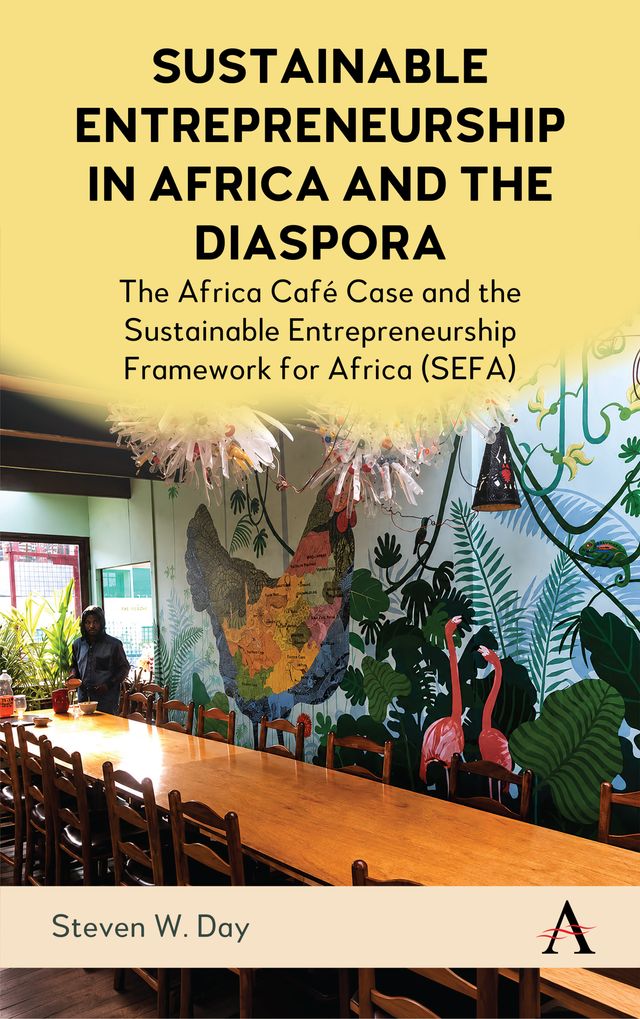
Narrates the story of Cape Town’s Africa Café and introduces the Sustainable Entrepreneurship Framework for Africa (SEFA), explaining how excluded entrepreneurs build and convert social, cultural, human, and political capital into financial capital across Africa and its diaspora.
In 1992, in a small house in Cape Town’s Observatory neighborhood, Portia Mbau began serving dishes gathered from her travels across the continent. What began as a family venture grew, with her brother Hector’s marketing and brand vision, into the Africa Café, a celebrated cultural enterprise at Heritage Square that seated the world at a communal table for nearly three decades before closing in the collapse of global travel in 2020. This book is the first full-length scholarly study of that enterprise: what one family built, what it meant, and what it teaches.
The book is built on primary interviews with Hector Mbau and sustained fieldwork in Cape Town, including the township of Langa. From this single richly documented case, it develops an original theoretical contribution, the Sustainable Entrepreneurship Framework for Africa (SEFA). SEFA integrates the five forms of capital (social, human, cultural, financial, and political) with the constraints of post-colonial economies and the linked processes of value creation and value capture. Its central mechanism, capital conversion under constraint, explains how entrepreneurs excluded from formal finance build the forms of capital available to them and convert them, through the value they create, into the financial capital the system withheld. The framework is stated in testable propositions, with explicit boundary conditions. The argument then travels. Comparative chapters set the Africa Café alongside township enterprise, continental African entrepreneurship, and the historic Black business districts of the United States, from Greenwood in Tulsa to Parrish Street in Durham, Jackson Ward in Richmond, Sweet Auburn in Atlanta, and Farish Street in Jackson, districts that built every form of capital except the political capital that might have protected them. A full chapter grounds the framework in the philosophy of Ubuntu, engaging both its promise and its critics. The book speaks to scholars and students of entrepreneurship, management, African studies, and development; to policymakers concerned with enterprise and empowerment; and to general readers drawn to the story of what one family built, what it meant, and what it teaches.