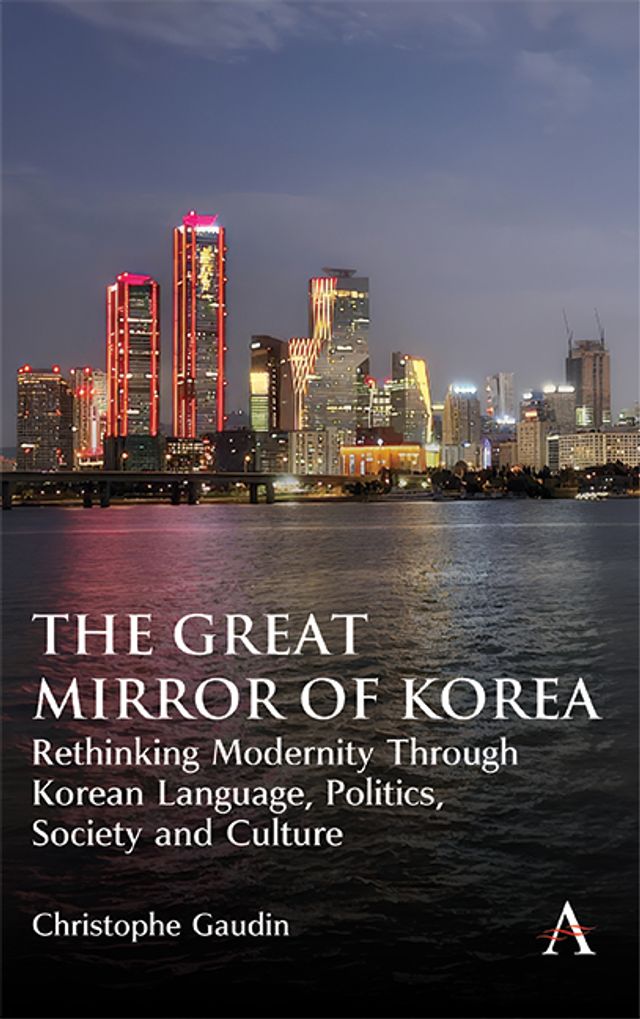
Christophe Gaudin
ISBN: 9781801362238
Pages: 150
Pub Date: April 2027
Imprint: Anthem Press
In this book, The Great Mirror of Korea, Christophe Gaudin, a professor at Kookmin University in Seoul, argues that Korea offers the clearest lens for understanding modernity’s global trajectory.
The title captures the book’s central claim: Korea has absorbed and transformed forms originating elsewhere, particularly in the modern West, more thoroughly than perhaps any other society. Drawing on Jack London’s 1910 story “The Unparalleled Invasion” and Karl Wittfogel’s Oriental Despotism, Gaudin traces how East Asian societies share a distinctive mode of learning and transmitting knowledge, visible in ideographic writing, calligraphy, ritual, and martial arts. This shared mode explains their capacity to appropriate Western institutions and turn them, with even greater force, against their originators. Korea’s singularity lies in how this mimetic capacity became directed almost exclusively toward the West, unlike in Japan or continental China, producing a society at the forefront of contemporary capitalism, and for that reason uniquely positioned to reveal its tensions.
The argument unfolds across four chapters, each grounded in local material rather than abstract theory. The first traces the arrival of Western modernity in East Asia and the lasting effects of Japanese colonialism on both Koreas, showing how Korea’s borrowed alphabet, Hangul, and its borrowed democratic ideals escaped the compromises that tainted them elsewhere. The second examines how Korean grammar, with its unstated subjects, its collective “we,” and its dense hierarchy of speech registers, encodes a relational worldview fundamentally different from that of Indo-European languages and traces its consequences through suicide statistics, matchmaking platforms, and drinking rituals. The third considers what became of democratic institutions once transplanted into this cultural environment, focusing on the Sewol ferry disaster, the impeachments of Park Geun-hye and Yoon Suk-yeol, and Korea’s pandemic response.
The final chapter turns to Korea’s most pressing contemporary crises, from the collapsing birth rate to the resurgence of authoritarian reflexes, and to the cultural forms, from Squid Game to Han Kang’s fiction, through which the country dramatizes its own condition. Throughout, Gaudin resists both nationalist self-flattery and Orientalist detachment, insisting that Korea’s story is not exotic but revelatory: a magnified image of the pressures and contradictions that late capitalism imposes on us all.