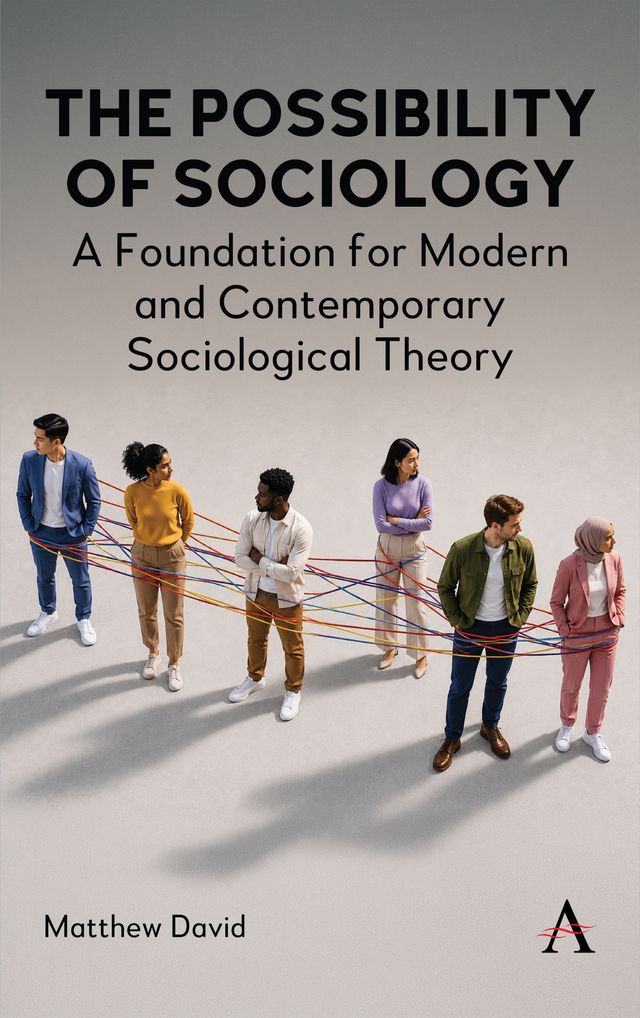


Matthew David
Paperback
£24.99 / $34.95
Hardback
£80.00 / $120.00
eBook (WEB PDF)
£25.00 / $35.00
eBook (EPUB)
£25.00 / $35.00
ISBN: 9781801362399
Pages: 100
Pub Date: April 2027
Imprint: Anthem Press
Proposes a new framework for sociological theory by integrating intersectional conflict, intrasectional diversity and heterosectional complementarity to explain society in a global context.
The Possibility of Sociology offers a foundation for sociology in today’s global world – integrating approaches that see society primarily in terms of intersectional oppression, intrasectional differences and heterosectional complementarity. There are many ways to study society. Thinking sociologically means thinking historically, geographically and critically. There are contradictions between political, economic and cultural logics. We can contrast structural logics: security, production, finance and knowledge. Critical accounts primarily debunk while still centring the Western canon. In contrast to stacking or attacking, this work offers to salvage and develop sociological theory.
Classical theories are valuable not for their specific claims (often wrong or partial) but rather in creating contrasts through which to think (conflict/consensus, agency/structure, culture/economy), laying the foundations for contrasting analytical frameworks today: intersectionality (highlighting oppression), intrasectionality (highlighting diversity) and heterosectionality (highlighting complementarity). The possibility of sociology lies in balancing these three frameworks, not in reducing explanation to one or even two dimensions. Structuralism and post-structuralism’s retreat from agency fused Marx and Durkheim to the exclusion of Weber. Parsons excluded Marx in fusing Weber and Durkheim. The Frankfurt School blended Marx and Weber against Durkheim’s positivism. Combining Marx, Weber and Durkheim (since 1971) created today’s sociological field.
Questions beset us. Do we live in one capitalist world system or has that order crumbled? An integrated global division of labour has increased the wealth of the world and for most people in it, even as cultural conflict can be sparked by the very processes of integration that have occurred. For all the wealth created by a globally integrated division of labour, inequality is growing. The ecological risks of economic development become increasingly apparent. The benefits of digital networks also afford new forms of hostility, moral panic and conspiracy thinking.
The insights that arise from a Durkheimian account of the organic division of labour offering mutual benefit even while creating increasingly different and specialised roles and identities (the heterosectional perspective) should be remembered when also noting the insights to be gained from intersectional accounts of multiple compounded or cancelling forms of inequality and exploitation (themselves drawing upon a Marxist conception of material interests and power), and the insights offered by a Weberian approach to the intrasectional (the diverse, changing and socially constructed nature of identities and cultures). These three perspectives offer insight, but each alone produces only a partial account. Each qualifies the insights of the others. The sociological imagination requires a balanced approach.