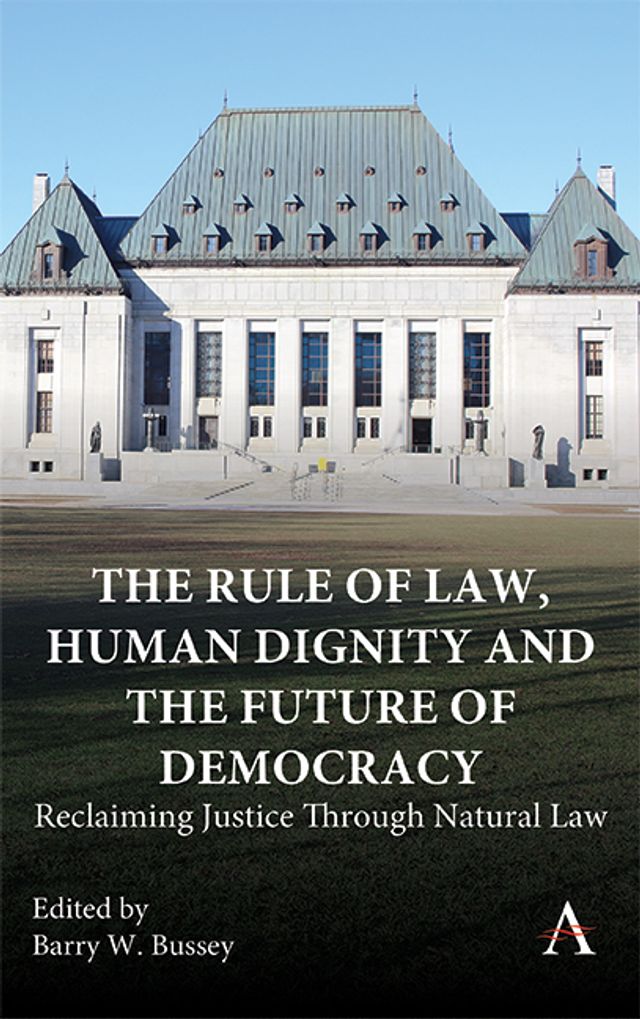


Barry W. Bussey
ISBN: 9781801361668
Pages: 250
Pub Date: April 2027
Imprint: Anthem Press
Examines whether the rule of law can endure without its natural law and metaphysical foundations, arguing for a renewed, human-centered legal order grounded in objective moral principles and capable of addressing contemporary challenges such as AI, technocracy, and decolonization.
This provocative interdisciplinary volume addresses a mounting global crisis: the erosion of the rule of law in an increasingly secular and technological world. As societies move into what the authors call the “fourth era” of legal history, the rule of law is frequently reduced to a mere “toolkit” for elites or a “checklist” for bureaucratic efficiency, stripped of its deeper moral and transcendent roots. The book explores a vital question: can legal systems remain just when they are “truncated of transcendence” and disconnected from a higher moral order? By sifting through the legacies of legal giants like Lon Fuller and theologians like Karl Barth, the contributors argue that a purely procedural “inner morality” is insufficient to protect human dignity against authoritarian relapses or the cold logic of “technocratisation.”
Central to the book’s unique vision is a multivalent, pluralistic re-envisioning of global norms. Drawing on the Christian philosophy of Herman Dooyeweerd, specifically his concept of “sphere sovereignty,” the authors propose a framework where diverse religious and secular traditions can collaborate without sacrificing their distinct identities. This approach offers a powerful way to decolonize the rule of law, moving away from “one-size-fits-all” Western impositions toward a culturally sensitive synthesis of universal principles and local traditions.
The text also tackles the controversial relationship between Natural Law and the 10 Commandments, debating whether positive laws should be grounded in “naturally knowable” truths or specific religious revelations in a pluralistic state.
Looking toward the future, the authors issue a stark warning against the rise of Generative AI (GenAI) in legal adjudication. They argue that replacing human value judgments with machine-driven algorithms threatens to eliminate the discretion and relational interaction essential to true justice. To counter this, the book calls for educational reform and a shift toward “principled legal education” that prioritizes ethics, restorative justice, and a “facts first” approach. Ultimately, this work is a call to action for legal professionals, theologians, and the public to reclaim law as a framework for human flourishing—a “language of love” between the divine and the human that protects the vulnerable from the arbitrary exercise of power.