

Connie Au
ISBN: 9781801361507
Pages: 250
Pub Date: March 2027
Imprint: Anthem Press
Examines how Catholic–Protestant collaboration in Cold War–era Hong Kong fostered education, social reform, ecumenical dialogue and cross-cultural cooperation within the colonial Chinese Christian community from 1966 to 1980.
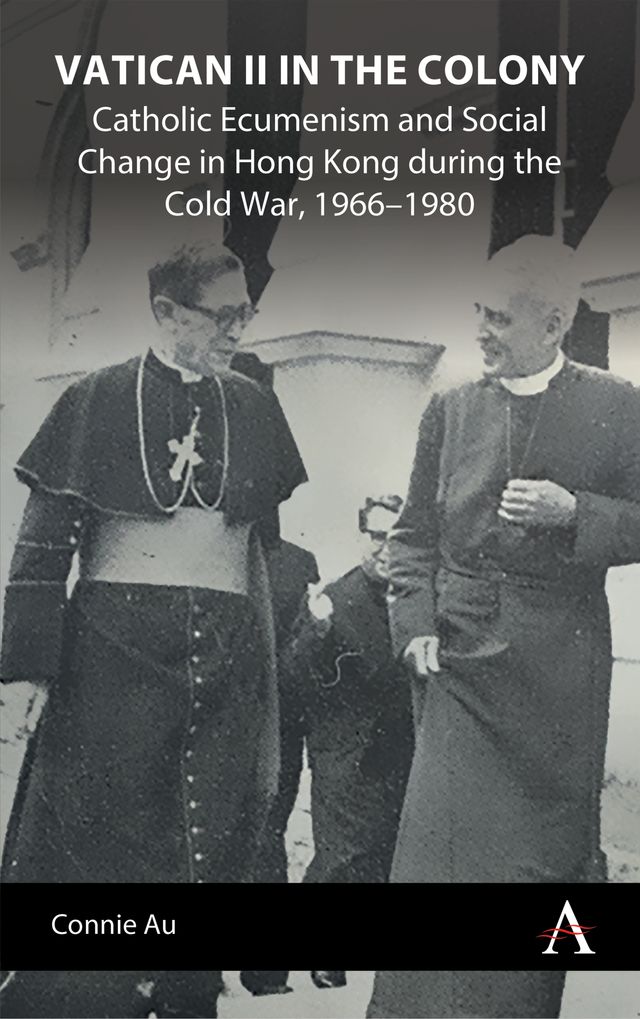
In the global politics during the Cold War, the role of churches seemed to be relatively minor compared to the sovereign powers and military allies of the two major blocs respectively led by the United States and the Union of Soviet Socialist Republics. However, in such a divisive world facing constant sporadic nuclear threats, the Vatican initiated the Second Council in 1962–1965, seeking to reform the Roman Catholic Church and to rebuild its relationship with the Orthodox Church and Protestant churches. The World Council of Churches, an ecumenical organisation bringing the Orthodox and Protestants, provided humanitarian aid to refugees fleeing from the communist countries to the free world. Hong Kong, as a British colony adjacent to China and Vietnam, played a major role in sheltering refugees from these two countries. With the assistance from Western and Chinese Catholic and Protestant churches and humanitarian organisations, the colonial government could launch massive educational and social welfare projects to improve the living and literacy standards of both local people and refugees. The result of this collaboration between these two Christian groups and the colonial government might be subtle, but their works gradually instilled the values of human rights, freedom, democracy and rule of law to the younger generation to counter communism for a long time. This enhanced the cultural, aesthetic and civilisation standards of the colony predominately populated by Chinese. Besides collaboration, these two Christian groups also sought to tackle doctrinal and biblical divisive issues. However, they were not always successful and the division still lives with the Chinese Christians in Hong Kong and elsewhere in the world. Since the Protestant groups in Hong Kong were involved in many churches and organisations, this book focuses on the ecumenical positions and efforts of the Catholic Church in Hong Kong and projects how it connected with the Protestants soon after the conclusion of Vatican II in 1966, and traces this collaboration until 1980.
Besides illustrating the ecumenical history of Chinese Christians, this book also records some Catholic and Protestant missionaries and lay people who made significant contributions to the colony and the church and deserve to be remembered. It provides a historical discussion on the Catholic diocese in China in ancient times and its reestablishment in Taiwan after 1949. This gives readers a wider perspective of the complicated background to the birth of the ecumenical movement in Hong Kong.