

Mike Watson
ISBN: 9781839999925
Pages: 150
Pub Date: September 2027
Imprint: Anthem Press
Examines the Frankfurt School’s insights on human alienation, digital media and artificial intelligence to explore contemporary environmental, social and political challenges.
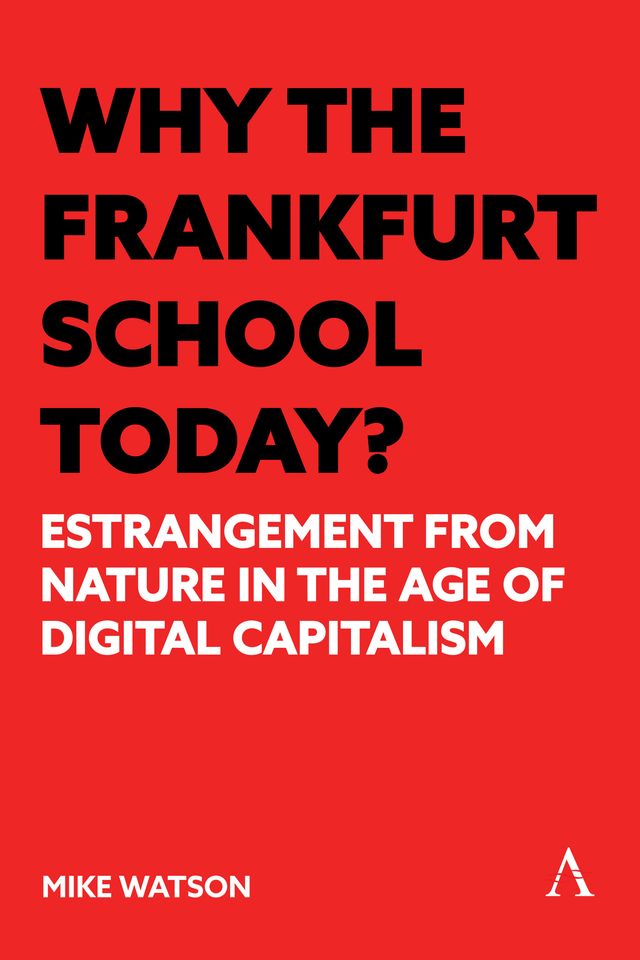
The book, Why the Frankfurt School Today? Estrangement from Nature in the Age of Digital Capitalism, assesses digital era living and our estrangement from nature, looking at the work of Adorno, Marcuse and Benjamin via philosophical research and observation of social media as well as a consideration of key Frankfurt School texts and lesser known works. This study serves as an introduction to key thinkers of the Frankfurt School as they relate to today’s issues of natural degradation, digital capitalism, social media and AI. The characteristic negativity of Adorno, charismatic positivity of Marcuse and esoteric enquiries of Benjamin will be assessed in their possible usefulness to the challenges of 21st-century media and its empowering and controlling effects. In an era of intense political currents, which arguably trace their genesis to capitalism’s alienating effects vis-a-vis humankind’s relation to nature, the Frankfurt School provides a historical reference point that can help us navigate the challenges we face.
Both an academic and layperson’s introduction, this book aims to provide a key to understanding the concepts developed principally by Adorno and Marcuse, which helped them address the alienating effects of industrialisation, warfare and urbanisation on humanity’s growing distance from nature in the interwar and post-war periods. Drawing on primary works from the 1930s to the 1970s, consumerist and media culture of the time, this book positions the works of the Frankfurt School as vital for confronting the key challenges of our time as challenges characterised by our ever-increasing alienation from ‘first nature’ (nature in its rawest, elemental form). Analysis of primary texts will help contextualise these key Frankfurt School thinkers in terms of contemporary social challenges.
In the industrial age, it was possible to talk of a ‘second nature’, as humanity’s ostensible break with and supersession of nature. The concept of second nature describes a period characterised by humans increasingly dominating one another in a mimicry of nature’s domination over all people, demonstrating that nature itself has not been overcome. The book introduces the author’s concept of ‘Digital Nature’, which gives the impression of fluid (rather than exploitative) working relations that are characterised by flexibility and an increasing level of agency on the part of workers and citizens generally. Aside from the internet, innovations such as the blockchain (including cryptocurrency and non-fungible tokens [NFTs]) and artificial intelligence reinforce this perception. These technologies are characterised by ease of use and lack of physical exertion that may give the impression of having superseded nature, and to a greater extent than in the industrial age. There is a popularly disseminated notion that AI will lead to a new era of human or post-human development with unprecedented levels of general societal wealth, or – conversely – lead to dystopia.
The term ‘Digital Nature’ acknowledges the similarity in form between the memetically diffused cultural units that characterise our cultural consumption and output in the digital age. However, it also points to our essential continued embeddedness within nature, potentially repeating the tendency towards domination that results from humanity’s essential similitude to, yet alienation from, the natural world. Furthermore, none of these technologies will necessarily resolve the problem of impending climate catastrophe and, given the high computing demands of AI and cryptocurrency, they may exacerbate them unless fueled by carbon-free energy resources.
The book will finally look to the thought of Adorno, Benjamin and Marcuse in asking how we might think about the negative effects of digital media and AI.