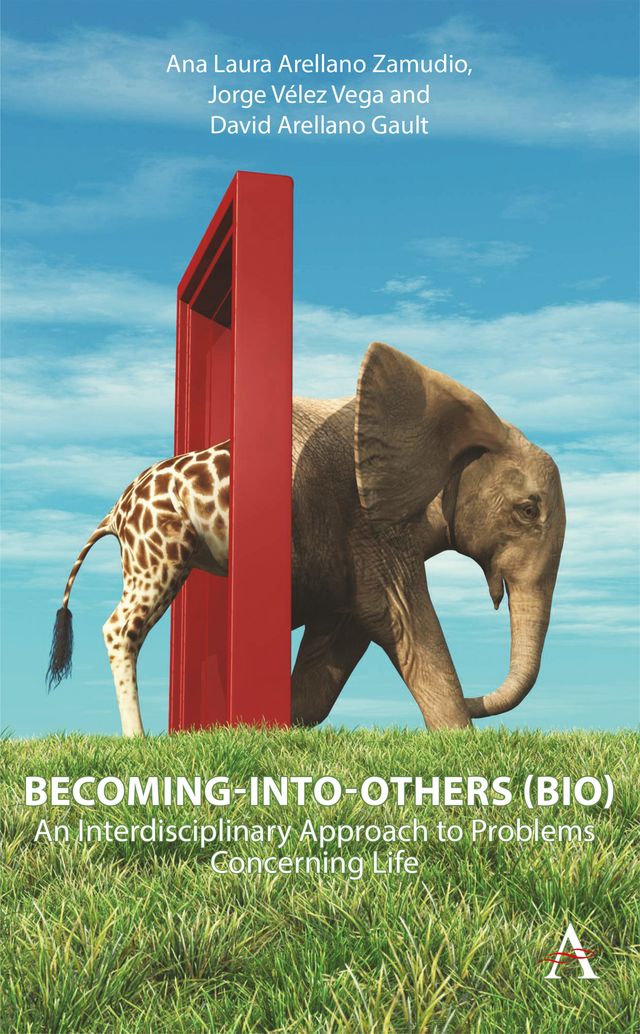


Ana Laura Arellano Zamudio, Jorge Vélez Vega and David Arellano Gault
ISBN: 9781839998485
Pages: 242
Pub Date: September 2026
Imprint: Anthem Press
Defines life as an ongoing process formed through dynamic connections among living beings, their environments, and the nonliving, in which life continually changes and transforms.
What is BIO? Usually used as a prefix before words such as logic, technology, mechanics, and mimetic, bio encompasses and brings together everything that can be recognized as life, as well as the connections and interconnections it establishes with the nonliving and the nonmaterial. In this way, life could not be known without the multiple connections and interconnections, which also act as a contrast and reflective counterpoint to life itself. Abstracted from its reality, life seems to be something that exists or simply is. However, as a flow that connects and interconnects diachronically and synchronically, life is something that is always becoming, at the same time that it is ceasing to be. It is therefore important to reflect on the prefix bio, understood as life, as a way in which one becomes. Thus, the living is not something that just exists, but rather something that changes, as it becomes something else.
Now, if life comes to and ceases to exist, it is due to the different connections and interconnections that arise internally–externally/micro-macroscopically between living things, as well as with their environments that include the nonliving and the nonmaterial. Through these connections and interconnections, living beings can change and, in any case, transform themselves. These changes and transformations do not occur in empty space, but within or in the middle of a place (a pond), a container (the stomach of a ruminant), or in a specific area (a coniferous forest). The connections and interconnections that living beings establish can be directed toward something or someone, because they do not live outside an environment (like the kingfisher, which relates to trees, lakes, or rivers; the fish and crustaceans it eats; the wind that allows it to move; and the water in which it dives).
Hence, rather than living under the subjection of external conditions, the living have an interest in fostering their connections and interconnections in other ways. In this sense, the concreteness of life, that is, the living in each particular case, shows in its abstraction that life itself changes and transforms within an environment, by directing itself toward something or someone in which one has a specific interest.