

Vijay Mishra and Sudesh Mishra
ISBN: 9781801360319
Pages: 240
Pub Date: October 2026
Imprint: Anthem Press
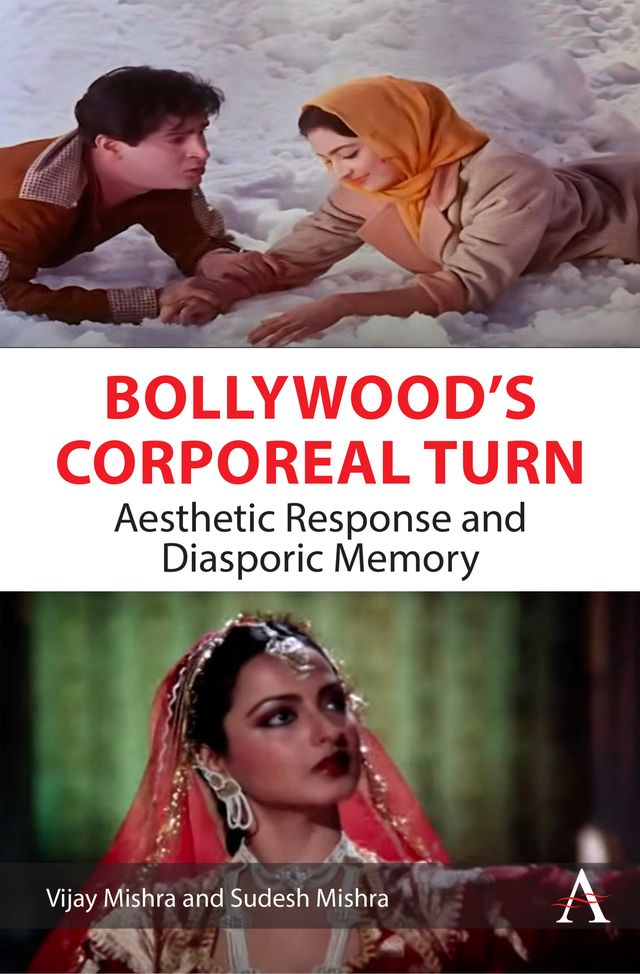
Explores Bollywood cinema’s aesthetic, cultural and corporeal dimensions across foundational genres, iconic performers and diasporic narratives, highlighting the interplay of narrative, poetry, the body and national and transnational identities.
The first substantive chapter of the book recovers the special allure of Parsi theatre and the role of the Muslim courtesan in Bollywood cinema. If the first provided a foundational cinematic scaffolding, the Muslim courtesan films gave the cinema its very special quality, more immediately the language of poetry in Urdu. There was nevertheless a tragic quality to the Muslim courtesan films and that tragic quality was given structural form through the ‘Devdas’ movies of the sentimental man of feeling whose life is marked by loss, failure to find the object of love and finally sacrifice in death.
Beginning with Chapter Two the book offers three genres that are foundational to any serious reading of Bollywood cinema. The first, dealt with in Chapter Two, is the genre of the Arabian Nights tales in as much as these fantasies provided a narrative base that emphasised India’s own inter-connected and diverse cultural heritage. The second, Bollywood mythologicals, examined in Chapter Three express what may be called the religio-cultural dominant of the nation. The third, examined in Chapter Four, is the disturbing fantasy of the darker, Gothic, side of humanity. However, when it came to the latter’s transformation in the established melodramatic genre of Bollywood, the Gothic took the form of reincarnation tales.
The book is defined by the correspondence between cinema and one’s passionate, sensual and even libidinal relationship to it. The corporeal aesthetic is read through two exemplary actors: Helen and Shammi Kapoor. They occupy Chapters Five and Six of the book, and both chapters have as their central theme precisely the question of the body in cinema and its articulation or representation either as an allegory of lived experience or as a redefinition of affective or precognitive understanding of the nation. Against the earlier emphasis on doctrinaire ethics, allegorical masculinity and nationalist ideology via a socialist realism, the libidinal enjoyment of the spectatorial image led to sensual delight and an understanding of the hitherto undertheorized aesthetic possibilities of the body in cinema.
The final substantive chapter (Chapter Seven) examines a dramatic turn during the first ten years of the third millennium. The book frames this shift with reference to elements of the diasporic imaginary captured in some of the films of the period and foreshadowed in the Prologue. In these films, Bollywood cinema unobtrusively enters the life-worlds of the burgeoning Indian diaspora and brings it into its own socio-political sphere. It is also a cinema where, beyond the confines of the Indian nation, the diaspora looks back at the homeland as a space of redemption as well as creativity but without uncritically embracing the jingoism and propagandist historical distortions that have in recent years confounded socio-political norms and bedevilled the nation via films like The Kashmir Files (2022), Chhaava (2025) and Dhurandhar (2025).