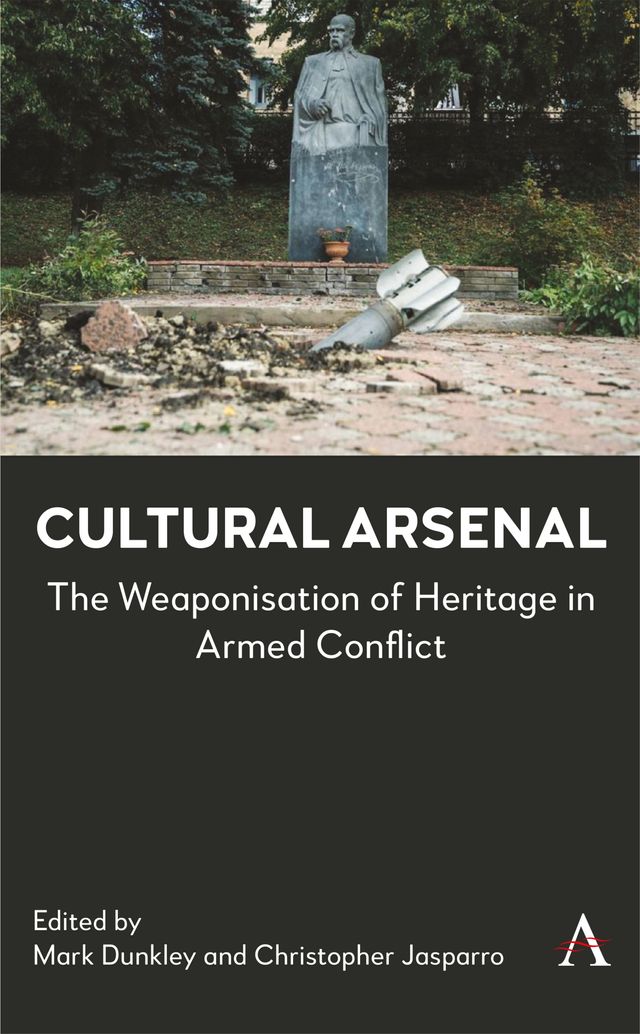


Edited by Mark Dunkley and Christopher Jasparro
ISBN: 9781801360814
Pages: 200
Pub Date: March 2027
Imprint: Anthem Press
Explores how cultural heritage has been exploited and weaponised by both state and non-state actors throughout history and in contemporary conflicts, revealing how monuments, traditions and historical narratives are manipulated for political, military and ideological gain, while also highlighting the resilience of communities striving to protect and reclaim their heritage against such attacks.
Cultural Arsenal: The Weaponisation of Heritage in Armed Conflict addresses head-on a dark and often overlooked aspect of cultural heritage: its weaponisation by both state and non-state actors. This new book is intended to show how cultural heritage has been used as a tool or weapon in contemporary conflict and geopolitical competition and how heritage has been manipulated and exploited throughout history to achieve strategic goals. The role of propaganda in the weaponisation of cultural heritage is also explored by examining how state actors use media and education to shape narratives around cultural heritage, often to justify territorial claims or suppress minority cultures. Within the context of International Humanitarian Law, these tactics highlight the importance of protecting cultural heritage during conflicts, as its loss can have profound and lasting impacts on communities, as well as the limits of international law in addressing the manipulation and exploitation of cultural heritage and its meaning. The book is therefore intended to explain – and set out – the exploitation of cultural heritage by both state and non-state actors to achieve military, economic, information, diplomatic and political advantage. By explaining this, the Editors aim to show how heritage has been weaponised in the past, and in the present, to achieve ideological successes as a component of advancing long-term interests. The narrative includes historical and current case-study examples, illustrating how empires and nations have used cultural heritage as a tool of propaganda. From political iconoclasm during the Ancient Egyptian Amarna period, to the aggressive program of Indigenous sequestration of Native American cultural practices in the nineteenth century, the book highlights how cultural heritage has been co-opted to serve strategic agendas across the Euro-Atlantic, Africa and the Middle East and the Indo-Pacific. Throughout the book, the contributors emphasise the resilience of communities in the face of such attacks. Stories of cultural preservation and resistance offer a glimmer of hope, showing how people strive to protect and reclaim their heritage despite the odds. This book is intended to be a thought-provoking and timely exploration of the intersection between culture and conflict. It calls for greater awareness and action to protect cultural heritage from being weaponised, urging readers to recognise the profound importance of preserving our shared history for future generations.