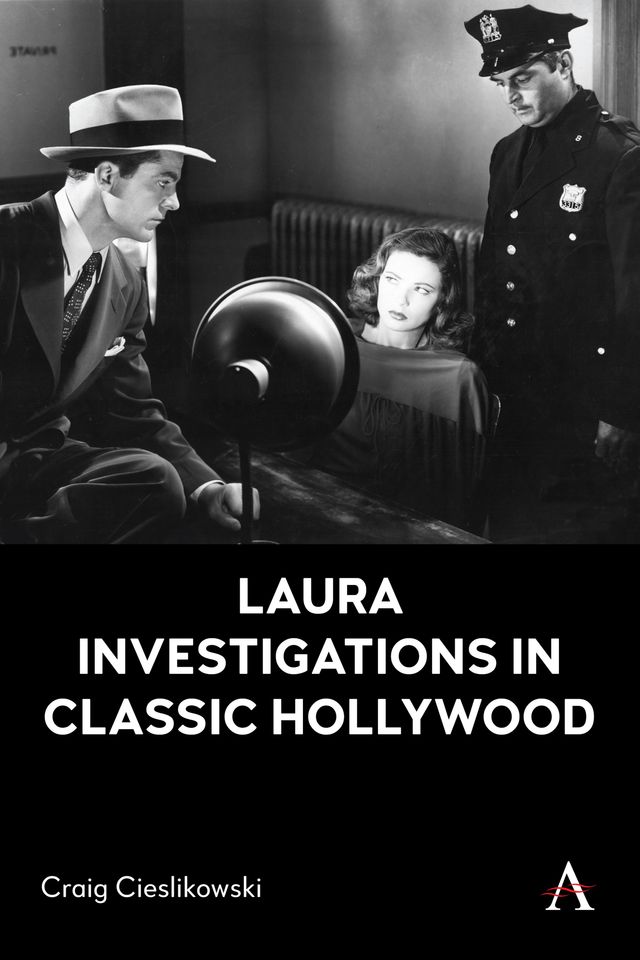


Craig Cieslikowski
ISBN: 9781839999581
Pages: 250
Pub Date: December 2026
Imprint: Anthem Press
Reveals new layers of the 1944 film Laura by using a filmmaker-like, detail-focused method to uncover its hidden complexities and reimagine the classic as a mysterious, ever-unfolding work.
Laura Investigations in Classic Hollywood focuses on Laura, the beloved, award-winning 1944 classic Hollywood detective drama, fondly remembered by audiences and critics alike for its noir elements, enchanting portrait, engaging performances, and romantic musical score. At once an exemplar of classic Hollywood’s finest achievements, Laura is also a film whose strangeness and mystery hint at something more. Laura Investigations in Classic Hollywood shows there are other ways to think about Laura by paying more attention to the film than is required or expected. This book argues that we can shed light on this fascinating movie by thinking like filmmakers ourselves. Casting Ludwig Wittgenstein and Pierre Bayard as unconventional investigative partners, this study closely analyzes Laura’s images and sounds.
Such an investigation requires a new method, a practical method, which we introduce to help us think like filmmakers. This method considers a film’s details and moments as “practicals,” props that appear on screen that work, like a light that a character switches on. We then turn on these practical details and moments to illuminate filmmaking choices and questions. We analyze scenes, imagine alternate filmmaking possibilities, ask unexpected questions, and speculate about events happening off-screen, both in the fictional world and in the real world of the filmmakers and viewers. Each line of inquiry results in transforming a well-known, award-winning film into a series of glimpses at a rather unknown film, one that we fall further in love with as we explore its mysteries.
Each chapter strives to produce a creative criticism that helps us understand the film differently and learn about filmmaking. After introducing the practical method, our investigation explores various issues of storytelling and memory. Then, we roam through different parts of the filmmaking process and examine filmmaking choices in a pair of chapters. We then scrutinize the on-screen world for two chapters by focusing on objects and props, which we follow throughout the film like suspects. Our investigation concludes as we use practical details and moments to provide summarizing problems for studying film like filmmakers. By the book’s end, we realize our investigation of Laura has uncovered the hidden complexities we overlook while watching any movie.