

Cynthia J. Becker
ISBN: 9781839998348
Pages: 100
Pub Date: December 2026
Imprint: Anthem Press
Investigates how Denis Martinez’s art, particularly 7 murs revisités (1989), draws on Amazigh art and other marginalized visual forms to articulate alternative forms of belonging and inclusion in postcolonial Algeria.
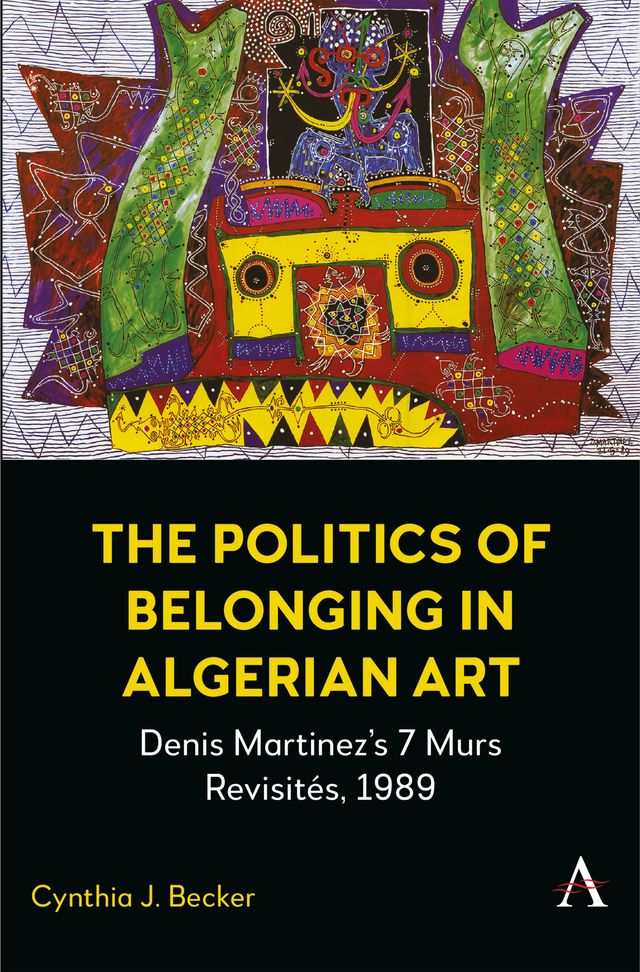
Denis Martinez’s 7 murs revisités (1989) was exhibited in the Kabyle region of Algeria, far from the institutional and political center of Algiers. The series consists of seven monumental canvases, each measuring approximately 200 × 300 cm, which rework Kabyle domestic wall painting into expansive pictorial fields animated by dense patterning and an anguished human figure emerging from a portal-like form. Installed in a communal setting, the exhibition fostered conviviality, dialogue, and cultural affirmation at a moment of intensifying political repression. By the late 1980s, the Kabyle house had become a charged reference within broader debates over national culture, as the Algerian state increasingly emphasized Arab-centered frameworks of identity. The works were never acquired by a museum and were later damaged by water after Martinez fled Algeria in 1993 amid the outbreak of civil war, underscoring their precarious position within both institutional and political histories.
7 murs revisités serves as the central focal point of this book, offering a lens through which to examine how visual culture articulated alternative models of belonging during a period of profound uncertainty. This study situates Martinez’s artistic career within debates over cultural legitimacy and social recognition in postcolonial Algeria. As an Algerian of Spanish ancestry, Martinez was acutely aware of the plural histories that historically shaped the country. In the decades following independence, multiple and competing modernist practices emerged, each negotiating the relationship between culture, politics, and national identity. Martinez’s engagement with Amazigh and other marginalized visual and symbolic forms in 7 murs revisités must be understood within this broader effort to articulate a conception of Algerian identity grounded in cultural recognition and inclusion.
This book offers an in-depth analysis of Martinez’s artistic practice, its critical reception, and the contexts in which his work circulated. As a founding member of the Aouchem collective, Martinez helped advance a vision of art as a social and symbolic force, famously encapsulated in the slogan “the sign is louder than the bomb.” His work consistently resisted rigid cultural hierarchies in favor of a humanist and pluralist ethos. By integrating calligraphic rhythms, geometric patterning, and figurative forms marked by vulnerability and strain, Martinez addressed the lingering trauma of colonial violence while probing the contradictions of post-independence nationalism.
When Martinez painted 7 murs revisités in 1989, his focus on the interior walls of the Kabyle house marked a decisive shift in his practice. This study argues that the series represents a form of strategic localism through which questions of belonging, memory, and cultural authority were made visible and collectively negotiated. 7 murs revisités stages belonging as grounded in lived social experience, an argument that lies at the heart of this book.